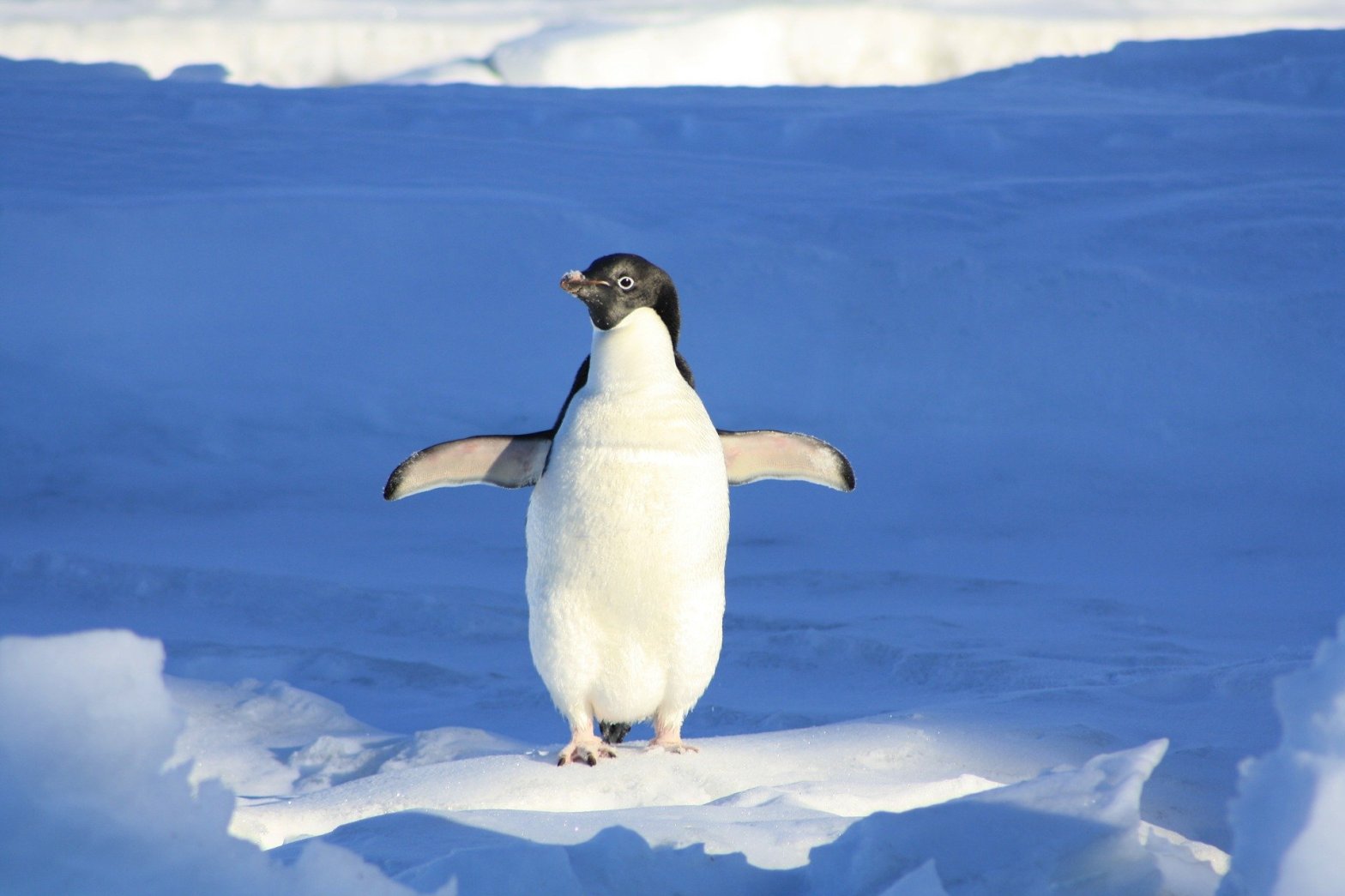
Image by Markus De Nitto/ Pixabay

While polar bears and seals continuously struggle to survive with reduced extents of sea ice in the Arctic, penguins in the Antarctic have higher hunting and breeding success, when there is less ice.
Scientists from the Japanese National Institute of Polar Research have studied the same group of Antarctic penguins for four breeding seasons between 2010 and 2017. The penguins always breed their chicks in the same area, a bay that is on the edge of continental Antarctic. Usually, the ice extends far above the ocean and the 70 cm high animals must walk on it, sometimes for hours, to reach their foraging area. They must find cracks that allow them to enter the sea, where they hunt for krill or small fish.
The penguins spent much of their time under the ice competing with other penguins for the same prey and searching for breathing holes, the scientists found when tracking 175 penguins with electronic devices. Both are energy consuming processes, that limit hunting success. Hunting and walking often takes up most of the day. Only after the penguins return to their colony, they can feed their offspring by regurgitating the predigested food and giving it to their chicks.
In the season of 2016/2017, something rare happened: a big portion of the ice broke off and got carried away by the sea, leaving the bay mostly ice free for this summer’s breeding season. As a result, the penguins could directly enter the water at their colony and swim through the shallow bay, to reach their hunting grounds. As they swim four times faster than they walk, that alone saved them much time.
Not depending on cracks in the ice, individuals could spread out more, reducing the competition with others. Therefore, their hunt was more energy efficient and more plentiful. As a result, adult and chick bodyweight increased and more offspring could be brought up in total. There is a direct link between shorter trips, more prey caught, and breeding success, as chick-feeding frequency (which is depending on trip duration) is very important for chick development.
Overall, an increase in sea-ice extent has been observed over the last 30 years, however, in the last two, ice has declined, and it is predicted that it will receding with climate crisis. This is good news for continental living Adélie, though their relatives, who breed on the edges of ice-covered Antarctic seem to be negatively affected by a reduced sea-ice coverage. It is therefore not expected that over-all penguin numbers will rise with climate crisis.
Reference:
Watanabe, Y. Y., Ito, K., Kokubun, N., & Takahashi, A. (2020). Foraging behavior links sea ice to breeding success in Antarctic penguins. Science Advances, 6(26), eaba4828.
 Science Bites